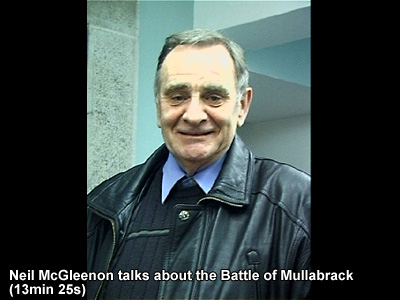

In the accompanying audio recording, Dr. Neil McGleenon, retired headmaster and local historian, talks about the Battle of Mullaghbrack in 1595, an engagement in the Nine Years War.
Use the audio controller to listen to this talk, given in 2003.
The above photo features Dr. McGleenon pointing towards what he considers to be the likely site of the battle.
In this section, you can read an article on the battle written by Dr. Neil McGleenon.
THE BATTLE OF MULLABRACK - 5TH SEPTEMBER 1595
Article by C. F. [Neil] McGleenon in Seanchas ard mhacha: Journal of the armagh diocesan historical society, edited by Réamonn Ó Muiri.During the Nine Years' War, the area between the Rivers Cully and Blackwater was the south-eastern military entrance into Gaelic Ulster from the English controlled North Leinster. English strategy was to keep this access operational and use it to strike at O'Neill's strongholds along the River Blackwater. In fact, the English failed to make this route secure until 1601. They could not count on sustained support from the Gaelic Lords who tended to support whichever side offered the most advantage at any given time, e.g., Sir Eochaidh O'Hanlon had opted for 'surrender and regrant' in 1587 but his sons were less inclined to support the English.
In 1595, Hugh O'Neill dismantled his castle at Dungannon and changed his strategy to a guerrilla campaign. Among his strongholds were the crannogs of Marlacoo Lake and Loch Rorc‡in near the River Cusher. O'Neill could also recruit significant local support among the septs of the O'Hanlons and MacDonnell Galloglas.
It was not until Lord Mountjoy built a line of forts that the English could establish a safe route from within the pale to the Blackwater region.
The Battle of Mullabrack received scant attention despite there being a number of notables involved: Sir John and Sir Thomas Norris and Sir Henry Bagenal to name but a few. It also proved worthy of mention in the communications between Lord Deputy Russell, Lord Burghley and Sir Robert Cecil.
The Battle took place as the English were on a second supply run to the garrison at Armagh. Contemporary accounts vary as to the exact time, place, duration and even outcome of the engagement. The 'Annals of the Four Masters' state the English were attacked on their way to Armagh and were forced to retreat to Newry,
"They marched to Newry and proceeded hence towards Armagh. When they had proceeded near halfway, they were met by the Irish who proceeded to annoy, shoot, pierce and spear them, so that they did not suffer them either to sleep or rest quietly for the space of twenty-four hours. They were not permitted to advance one foot further and their chiefs were glad to escape with their lives to Newry".
Other accounts by Bagenal and Captain Francis Stafforde state the battle took place some three days following the delivery of supplies to the garrison at Armagh and in fact the English were returning to Newry.
The precise location of the Battle is not known and only one Gaelic source identifies Mullabrack, "Norris again set out in force to recover Armagh. At Mullabrack, in Orior, O'Neill ventured a battle and routed and scattered the enemy who, reorganised by Norris, renewed the fight. Again they were defeated by the skill and valour of O'Neill's gunmen and of Maguire, his master of horse. For a second time reanimated by Norris they renew combat [and] for a third time are compelled to retire - Norris himself receiving a wound". ('Historia Catholicia' 1621 - translation from Latin)
After two hours of fighting the English were low on shot and forced to retreat. Stafforde reported,
"An English gelding which he (Sir John Norris) then was mounted upon was shot in four places and his Lordship received a shot in the belly, and one other shot in the right arm; his brother Sir Thomas shot through the left thigh without peril of bone and his horse hurt; Captain Richard Wingfield shot through the left elbow; Lieutenant West killed.."