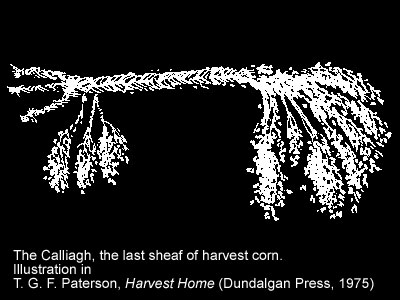
HARVEST CUSTOMS IN COUNTY ARMAGH THE CALLIAGH (THE LAST SHEAF)
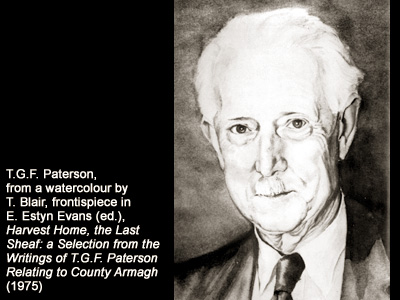
from T. G. Patterson, Harvest Home: The Last Sheaf (Dundalgan Press, 1975).
pp. 197-201.
The investigation of types of "Harvest Knots" led to the examination
of other harvest customs, such as the cutting of the Calliagh, the Churn and Harvest
Home. Methods and descriptions were taken down in detail and published with townland
locations in the Ulster Journal of Archeology. [1] The search showed that the
ritual of cutting the Calliagh varied somewhat, even in adjoining townlands. That,
however, was to be expected in an area like Armagh containing large numbers of
English and Scotch settlers. The following account, taken down in the parish of
Ballymore, illustrates the general procedure in County Armagh:
"At the cutting of the corn the last handful would be left uncut, and
that wud be divided into three and platted by one of the weemin who'd be tying.
Then the men would throw their hooks at it from a butt. I niver saw the hooks
thrown at it, but I know that's how it was done. In my time it wus cut be
the scythe, though mebbe it was done in the oul' way still by a body with
only a rood or two of oats that they'd shear in the evenings when their work
would be done on somebody's farm. We took the Calliagh into the house and
on that evening there'd be a bit of a spread. I heared of people sending it
to their neighbours whose harvests would not be finished. But why they did
it I do not know. It wus mebbe a joke for them that got it would be very angry."
I made no attempt to classify under nationalities the accounts noted down throughout
the county as I fear that the custom as now practised bears English and Scotch
imprints, but though the collected versions varied in detail they tallied closely
in the main points. The information obtained may be briefly summarized as under:
I. The Calliagh was first plaited, then cut by throwing the sickle from an arranged
butt or mark and the sickle was thrown in a particular way known as backhand,
which method was necessary to make the hook spin so that the plait could be cut
by circular motion.
II. When cut it was carried into the house and placed around the neck of the farmer
or his wife, the latter, for some reason, being the person most frequently selected
for the honour. Later it was hung in the kitchen where it usually remained until
the next harvest.
III. Women occasionally took part in the throwing of the sickle and were sometimes
given the privilege of preparing the plaited Calliagh for cutting.
IV. The children were often led to believe that the Calliagh was alive and hiding
in the corn, or caught in the plait and that it would later be used to hang their
mother!
V. The cutting was sometimes preceded by cries of "cut her down, cut her
down" and when accomplished greeted by cheers.
VI. A special meal always followed the cutting ceremony, generally known as "The
Churn," and in some districts dancing was a feature of the proceedings.
VII. When placed in the house, the Calliagh should be carefully preserved until
at least the Spring, at which time the grain should be removed and sown. If kept
until the next harvest the grain should then be fed to animals or fowl. It should
not, under any circumstances, be burned unless the grain is first taken away and
it should always be hung with the stems facing left and the grain to the right.
In certain districts where the population is largely of English and Scotch descent
I found some decorated plaits called "Dressed Calliaghs," a type that
sometimes hnds a place in harvest decorations at the annual Church Festival following
the gathering in of the crops. Miniature corn ricks are another feature of the
same festival and they are indeed works of art, the building of them requiring
deft fingers and an eye for proportion, besides patience in shaping and thatching.
Usually they are from two to two and a half feet high and beautifully proportioned.
The cutting of the Calliagh is still carried out on many farms and I saw numbers
of specimens in houses in all parts of the county during my enquiries. Those that
I saw had, of course, been plaited before being snigged by the scythe.
In the earlier stages of the war, when tillage had but slightly increased, there
was still a little leisure in country districts for cults of the past, but now
that every farmer has more land under cultivation than he can properly cope with,
there is less time for remembrance of old customs. The cutting of the Calliagh
is undoubtedly passing and, of course, with it the Calliagh Feast. The cult of
the harvest knot is also decaying. The young people like to sport it but few are
skilled in the making of it. This is specially noticeable amongst the boys and
may be due not so much to lack of interest as to the fact that the older people
and girls are willing to fashion knots for them.
Armagh is a county of surprise and contrast. In some of the more hilly districts
primitive methods of agriculture remain. Potatoes may still be seen under "lazy-bed"
cultivation and when seed-grass and oats are ready for threshing it is the old
beating-stick and flail that come into use. In other parts tractors are quietly
superseding horses in ploughing and preparing land for cropping and in the harvest
season mechanical reapers and binders are plentiful. In such districts the old-fashioned
horsedriven farm threshing machine has given way to the steam or other mechanized
type of thresher, just as it, itself, drove the flail out of action. And yet the
flail-threshed oats and wheat were much superior to steam-threshed. Twelve stones
of such seed was ample to sow an acre but steam-threshed grain is so bruised and
damaged that eighteen stones are required for the same purpose. That, with much
other agricultural information, came to light during investigations. Such facts,
however, have no bearing on harvest customs so cannot be dealt with here.
In conclusion, I should like to record that in 1944 Professor Evans and I saw
harvest knots worn at the Lammas Fair in Ballycastle in July, and in November
I noticed examples being sported in the fairs of Ballygawley and Enniskillen.
I also saw specimens being displayed in the cities of Derry and Belfast and in
certain districts in Down and Tyrone. The area covered by the above observations
shows that the custom prevails to some extent in every county in Northern Ireland.
I should also like to mention a practice that prevailed on the Armagh-Down border
until quite recently—the making of representations of human figures in oat
and wheat straw. Some were actually life-size and there are people living today
in the neighbourhood of Poyntzpass who well remember a pair of such figures, male
and female, in a house near the village. I first learned of their existence in
1940 and immediately visited the locality. Unfortunately the house in which they
were preserved had passed into new ownership since my informant had seen them
and they had been destroyed. The inhabitants of the adjoining farm-houses could
advance no reason as to their original purpose, though quite familiar with the
figures. They were not fragments of straw head-dresses and cloaks of the type
known to have been worn in the county at certain festivals or ceIebrations [2]
but complete straw-clothed human-shaped figures with masks. No details are available
as to whether they were actual effigies, or costumes with masks and head-dresses
capable of having been vvorn over ordinary clothing. Could the so-called figures
possibly be a survival of the custom noted on the Armagh-Louth border by John
Donaldson [3] circa 1838 in which a man and woman fantastically dressed with straw,
danced around a female figure displayed on a pole. Donaldson describes the ceremony
in detail and ascribes to it a "fecundity" cult. Were the Poyntzpass
figures survivals of a similar practice discontinued at some date beyond the ken
of the people now living in that locality? Could the figures have been a pair
of such straw costumes with masks, retained originally because of pride in workmanship,
and later for sentimental reasons preserved by a generation that had quite forgotten
their purpose, or perchance had never learned it?
Footnotes
1. Vol. 5 (1942), pp. 2-7 and Vol. 7 (1944), pp. 108-116.
2. Jack Straw, a character in the Christmas Rhymers, was usually so attired.
3 Historical and Statistical Account of the Barony of Upper Fews in the County
of Armagh, 1838. Tempest, Dundalk, 1923.